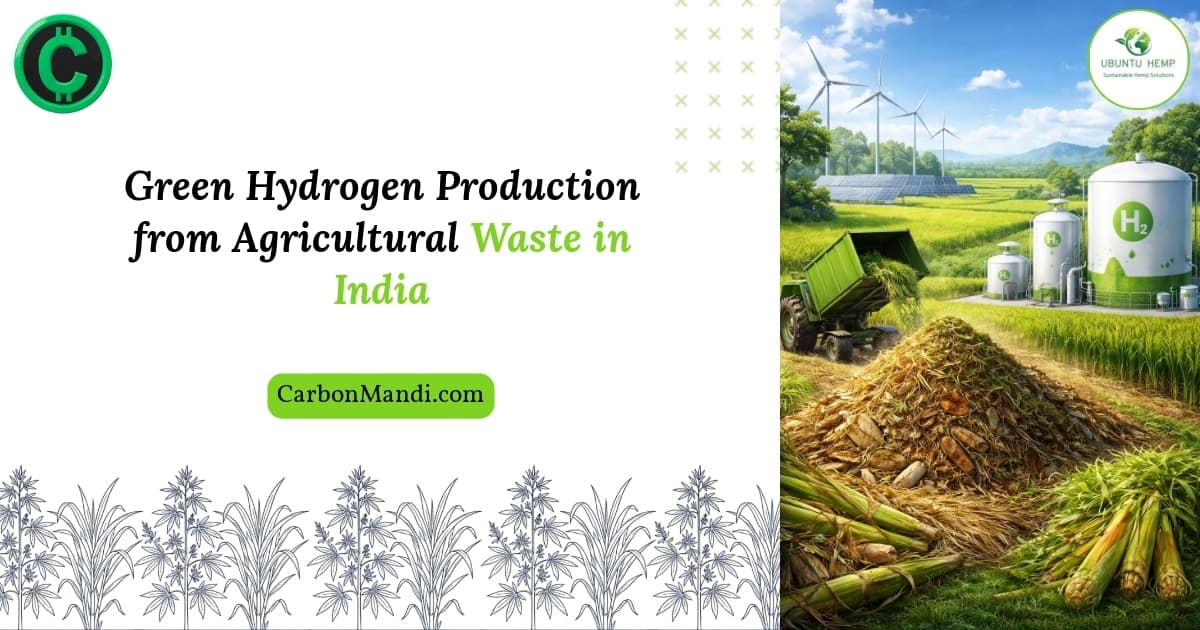
Green Hydrogen From Agricultural Waste: India’s 2026 Energy Shift
- Carbon Credits
- Green Hydrogen From Agricultural Waste: Complete Guide for India 2026
- Sustainability
Table of Contents
- Rethinking Energy: Why Green Hydrogen?
- Turning Waste Into Power: The Process Explained
- India’s Roadmap: Practical Steps Forward
- Success Stories Lighting the Way
- Questions on Green Hydrogen Answered
- Taking Action: Join the Movement
Rethinking Energy: Why Green Hydrogen?
Imagine a fuel that burns clean, emits only water vapor, and can be made from the leftovers of farming. That’s green hydrogen from agricultural waste, a game-changer for India’s energy future. With millions of tons of crop residues produced annually, India faces both a pollution problem and an energy opportunity. Instead of burning this waste and worsening air quality, converting it into green hydrogen offers a sustainable solution.
This approach not only tackles pollution but also supports India’s commitment to renewable energy goals. Green hydrogen from agricultural waste is gaining traction as a viable alternative fuel, especially for industries and transportation sectors aiming to reduce carbon footprints. The keyword "Green Hydrogen From Agricultural Waste: Complete Guide for India 2026" fits perfectly here as this guide explores how India can harness this potential by 2026.
Turning Waste Into Power: The Process Explained
The journey from agricultural waste to green hydrogen involves several key steps. First, biomass such as rice husks, wheat straw, and sugarcane bagasse is collected and pretreated to remove impurities. Then, through gasification, this biomass is converted into a synthesis gas (syngas) rich in hydrogen.
Next, the syngas undergoes purification to isolate hydrogen. This hydrogen is then stored or directly used as fuel. Unlike fossil fuels, this process emits minimal greenhouse gases, making it a clean energy source. The technology is scalable and adaptable to rural and industrial settings, which is crucial for India’s diverse agricultural landscape.
India’s Roadmap: Practical Steps Forward
India’s path to widespread green hydrogen adoption from agricultural waste involves coordinated efforts. First, infrastructure development is essential. Setting up decentralized biomass gasification plants near farming hubs can reduce transportation costs and emissions.
Second, policy incentives like subsidies and carbon credits can encourage farmers and entrepreneurs to participate. Third, research and development must focus on improving gasification efficiency and hydrogen storage technologies. Public-private partnerships will play a vital role in scaling these solutions.
By 2026, India aims to integrate green hydrogen into its energy mix, reducing reliance on imported fuels and cutting pollution. This strategy aligns with national goals for energy security and climate action.
Success Stories Lighting the Way
In Maharashtra, a pilot project converted sugarcane waste into green hydrogen, powering local transport and small industries. This initiative reduced local air pollution and created new jobs in rural areas. Similarly, Punjab’s wheat straw gasification plants demonstrated how agricultural residues can fuel hydrogen production without competing with food crops.
These examples highlight the feasibility and benefits of green hydrogen from agricultural waste. They also provide valuable lessons on community engagement and technology adaptation, essential for replicating success across India.
Questions on Green Hydrogen Answered
What about the cost? Initially, green hydrogen production from agricultural waste can be expensive due to technology and infrastructure needs. However, costs are expected to drop with scale and innovation.
Is it reliable? Yes, biomass availability is seasonal but can be managed through storage and diversified feedstock use. What about environmental impact? This method significantly reduces air pollution compared to open burning of crop residues.
These considerations are critical for stakeholders evaluating green hydrogen projects in India.
Taking Action: Join the Movement
India’s green hydrogen future depends on collaboration. Farmers, businesses, policymakers, and consumers all have roles to play. To stay informed and connected, Join our WhatsApp community.
Explore partnerships, support local projects, and advocate for policies that promote sustainable energy. Together, we can turn agricultural waste into a clean energy powerhouse.
Carbonmandi building this With the advisory of Ubuntuhemp.